Symmetric vs. Asymmetric
Symmetric
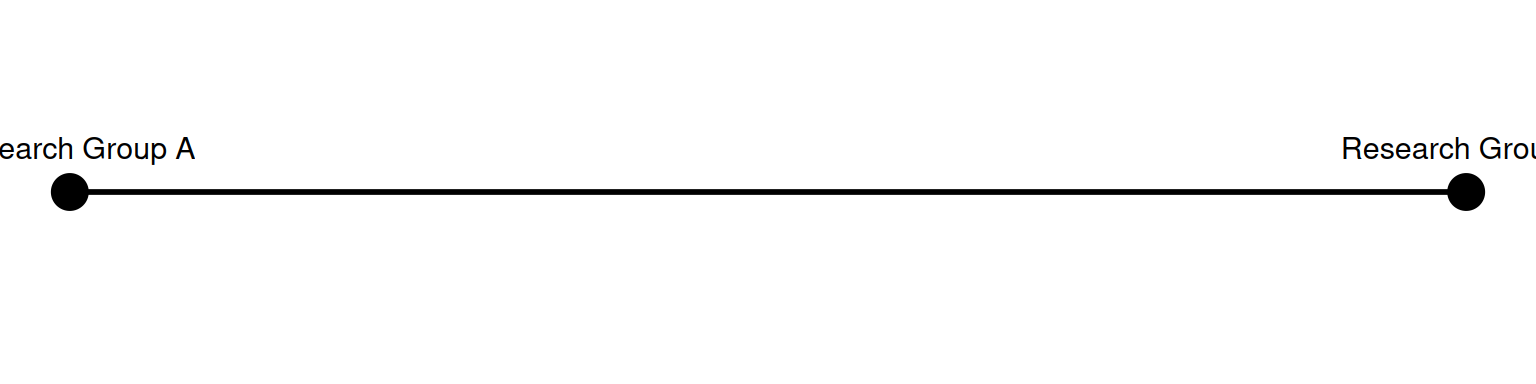
So far, we have been looking at symmetric relationships. These are dyads with ties which have no direction – i.e. the relationship is mutual.
In a symmetric dyad:
- If Node A is connected to Node B,
- then Node B is equally connected to Node A.
Symmetric networks are often used when:
- the relationship is inherently mutual (e.g. collaboration)
- or when data is simplified into a binary condition (i.e. tie vs. no tie).
Example: collaboration network
NoteJargon
Other ways of describing symmetric relationships:
- mutual dyad
- undirected ties
- reciprocal relationship (in interpretation, though not always observed directly).
Asymmetric
Asymmetric relationships introduce direction.
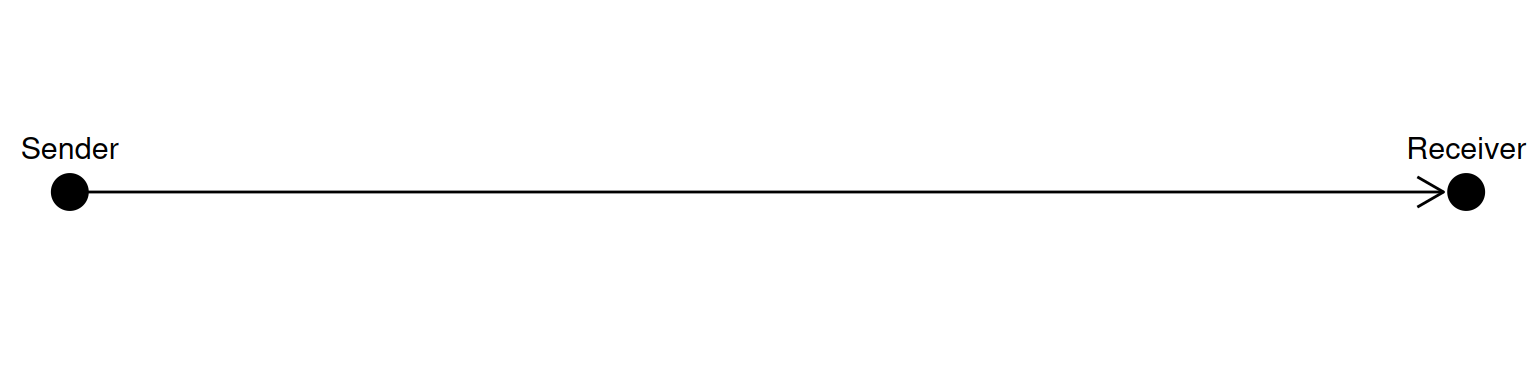
In an asymmetric dyad, a tie goes from one node to another, but not necessarily in return:
- Node A → Node B does not imply Node B → Node A
These are also known as directed ties, and are typically shown using arrows.
Asymmetric networks are useful when relationships involve flow, influence, or action.
Note
Examples include:
- communication (who sends messages to whom)
- citation networks (which paper cites another)
- customer relationships
- supervision or reporting structures
Example: directed relationship
NoteJargon
Other ways of describing asymmetric relationships:
- directed dyad
- non-reciprocal tie
- sender → receiver relationship