Network Structure
This section introduces ways of describing the structure of a network.
Understanding structure helps us interpret how nodes are connected and how information or influence might flow.
Structural holes
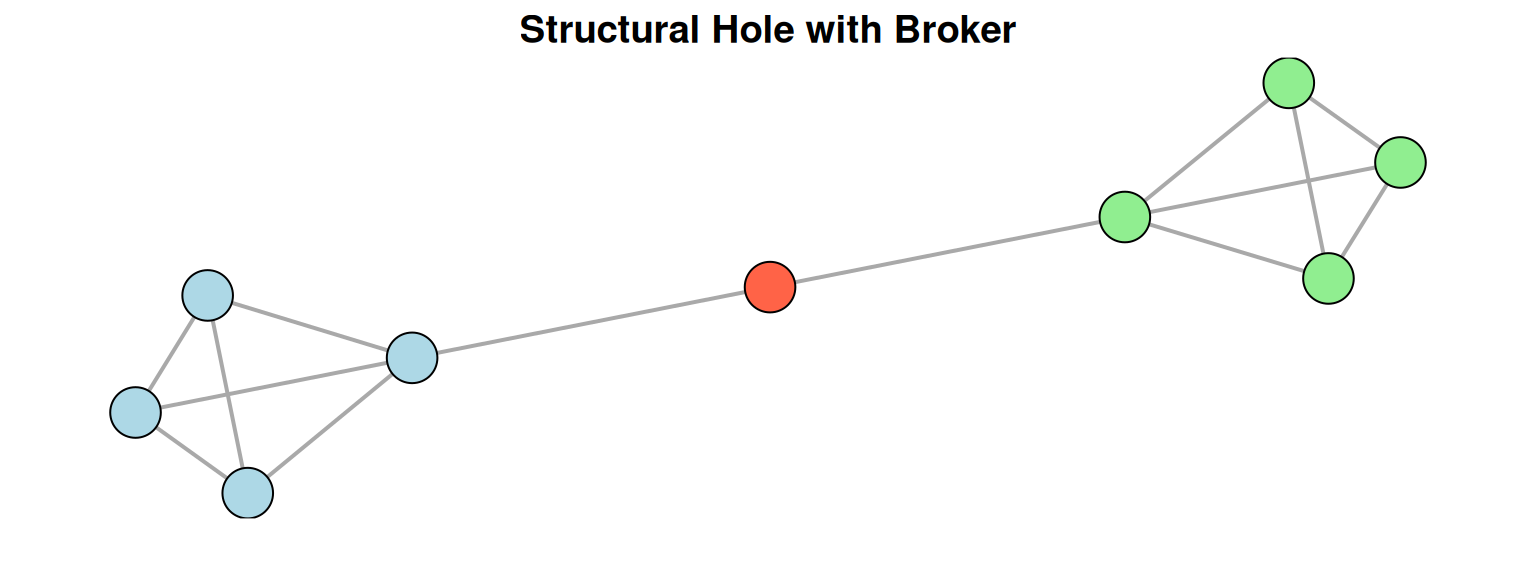
A structural hole exists when two nodes (or groups) are not directly connected.
A node that connects these otherwise unconnected parts of the network can act as a broker.
- brokers may control or mediate information
- they can connect groups that would otherwise remain separate
Note
Brokers aren’t necessarily the most connected — they are the most strategically positioned.
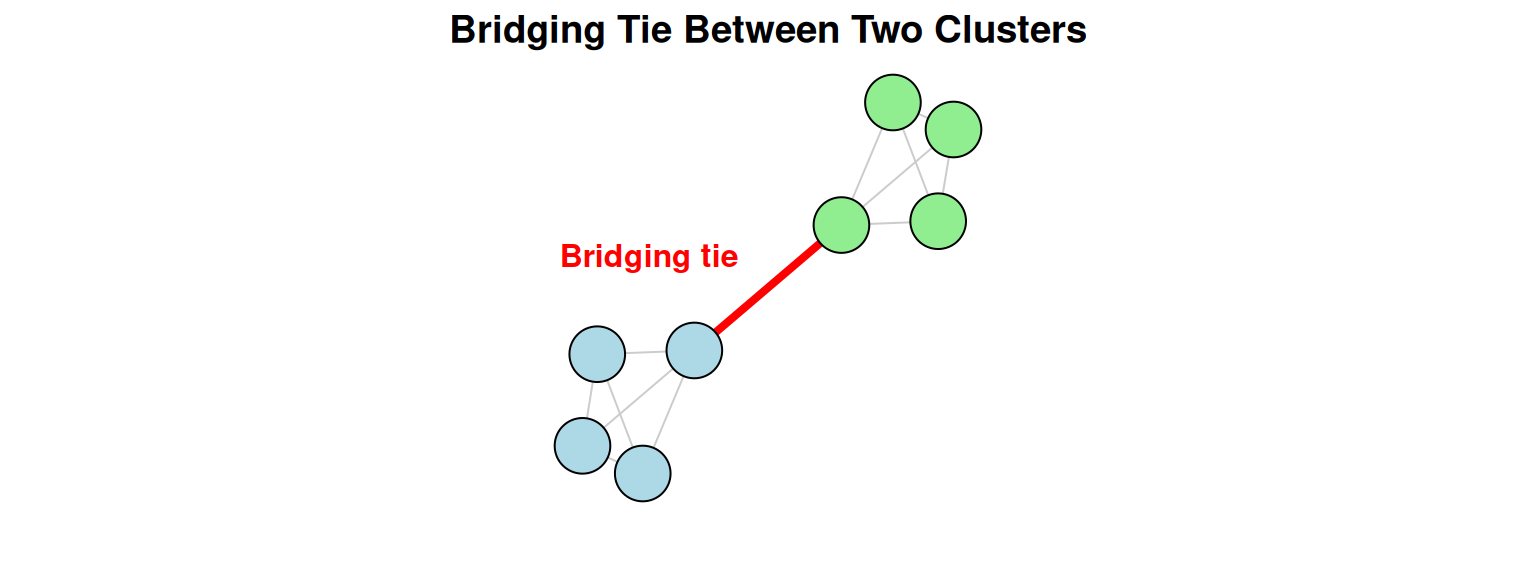
These two clusters are not directly connected. The only way information can pass between them is through the broker which acts as a connecting tie between two otherwise disconnected parts of the network. It is possible to have two reciprocal brokers with a bridging tie.
Bridging ties
Bridging ties are connections that link different parts of a network.
These ties are often:
- less frequent or weaker
- but important for connecting otherwise separate groups
Bridging ties help networks become more connected overall.
Density
Density describes how connected a network is overall.
It is calculated as:
the number of actual connections
divided by the number of possible connections
High density → many connections
Low density → fewer connections
Dense networks tend to be more tightly connected.